
Frank Gehry (1929–2025): The Architect Who Taught the World to Dream in Curves
Few architects have shifted the global imagination the way Frank Gehry did. His buildings weren’t just structures — they were gestures, volumes in motion, shimmering sculptures that redefined skylines and rewrote the emotional grammar of contemporary architecture.
With his passing on December 5, 2025, at age 96, the world says goodbye to a visionary. But his legacy continues to bend light, inspire cities, and challenge the ordinary.
From Toronto to the World
Born in 1929 in Toronto as Frank Owen Goldberg, Gehry discovered early that architecture could be more than geometry. After moving to Los Angeles, he graduated from USC and later studied urban planning at Harvard. In 1962, he opened his own studio — a small office that would later become one of the most influential creative hubs in the world.
The Signature That Didn’t Follow Rules
Gehry never belonged to a category.
He invented his own.
From his experimental remodel of his Santa Monica home — using corrugated metal, plywood, industrial fencing — to the titanium waves that became his signature in the 1980s and beyond, Gehry explored architecture as fluidity. His buildings refused symmetry, refused predictability. They danced.
Landmarks That Changed Cities
Some architects design beautiful buildings. Gehry designed destinations.
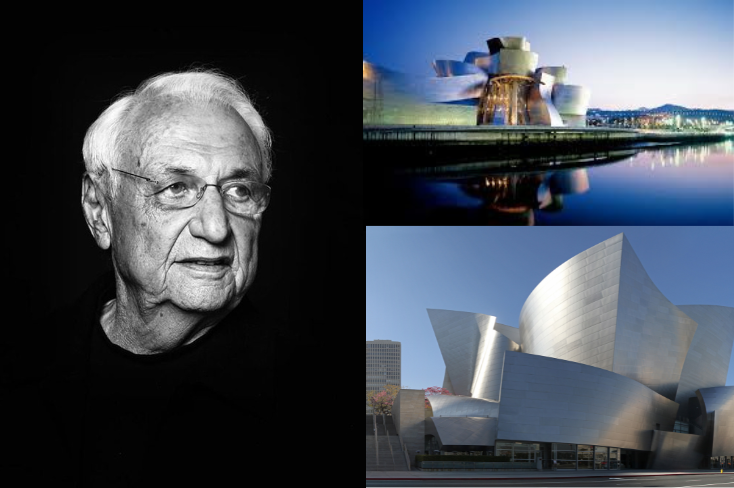
Guggenheim Museum Bilbao (Spain)
A turning point in cultural history. Inaugurated in 1997, the museum didn’t just elevate Bilbao — it transformed it, giving rise to what the world now calls the Bilbao Effect.
Walt Disney Concert Hall (Los Angeles)
A metallic symphony. Gehry turned a concert hall into a sculpture that captures the sun like an instrument captures breath.
8 Spruce Street (New York)
A 76-story twist in the Manhattan skyline — one of the rare skyscrapers with personality.
Fondation Louis Vuitton (Paris)
A contemporary vessel set to sail through the Bois de Boulogne.
Receiving the Pritzker Prize in 1989 only confirmed what the world already knew: Gehry was not an architect. He was an artistic force.
More Than Buildings: Urban Poetry
What Gehry really built was possibility.
He proved that architecture can:
spark tourism,
revitalize neighborhoods,
shift economies,
create cultural identity.
His pioneering use of digital modeling allowed him to sculpt buildings the way artists sculpt clay — and inspired a new generation to expand the limits of form.
The Legacy Lives in the Curves
Frank Gehry leaves us with spaces that pulse with imagination. Places that turned cities into open-air galleries. Structures that remind us that practicality and poetry can — and should — coexist.
He didn’t simply design;
he invited us to see the world differently.
And long after his final blueprint, his buildings will continue doing exactly that.
Font: nytimes.com